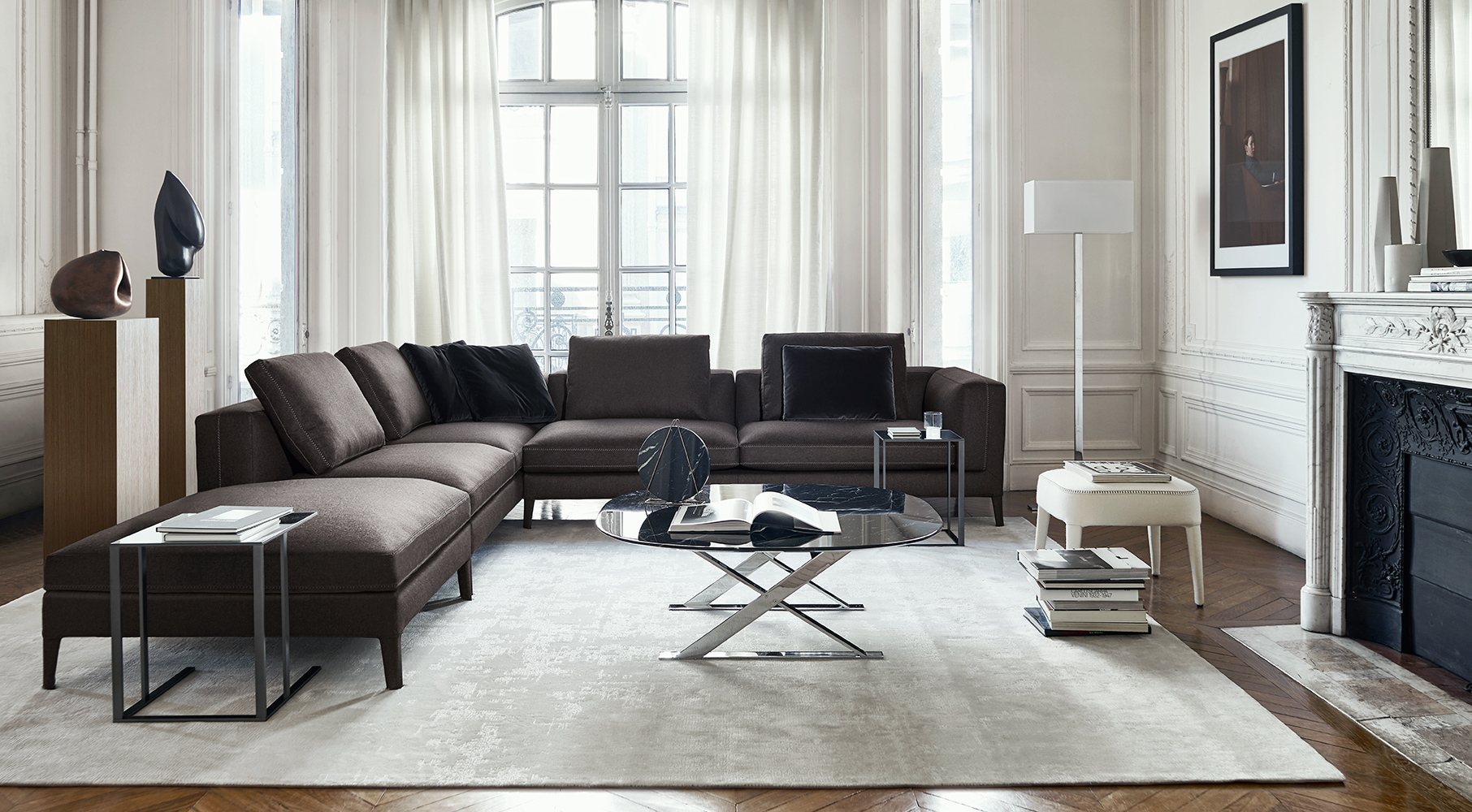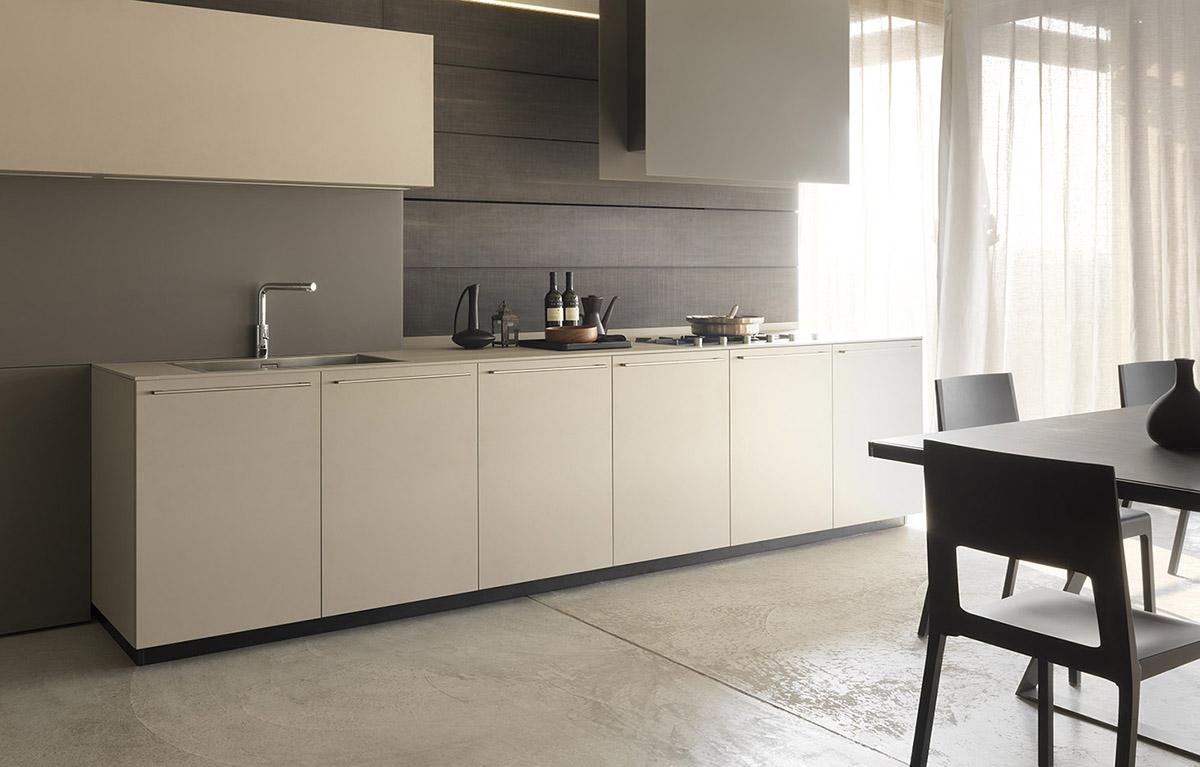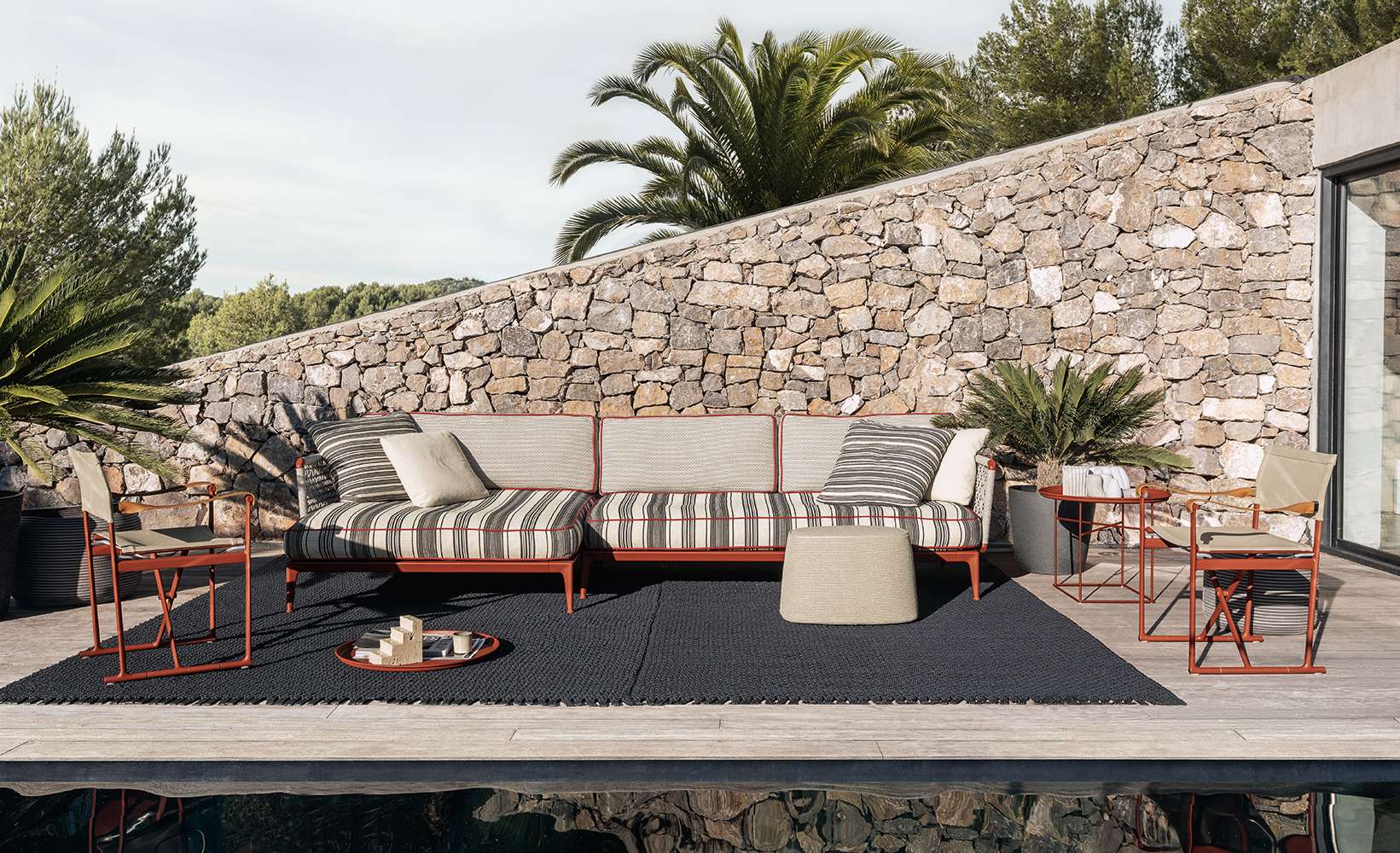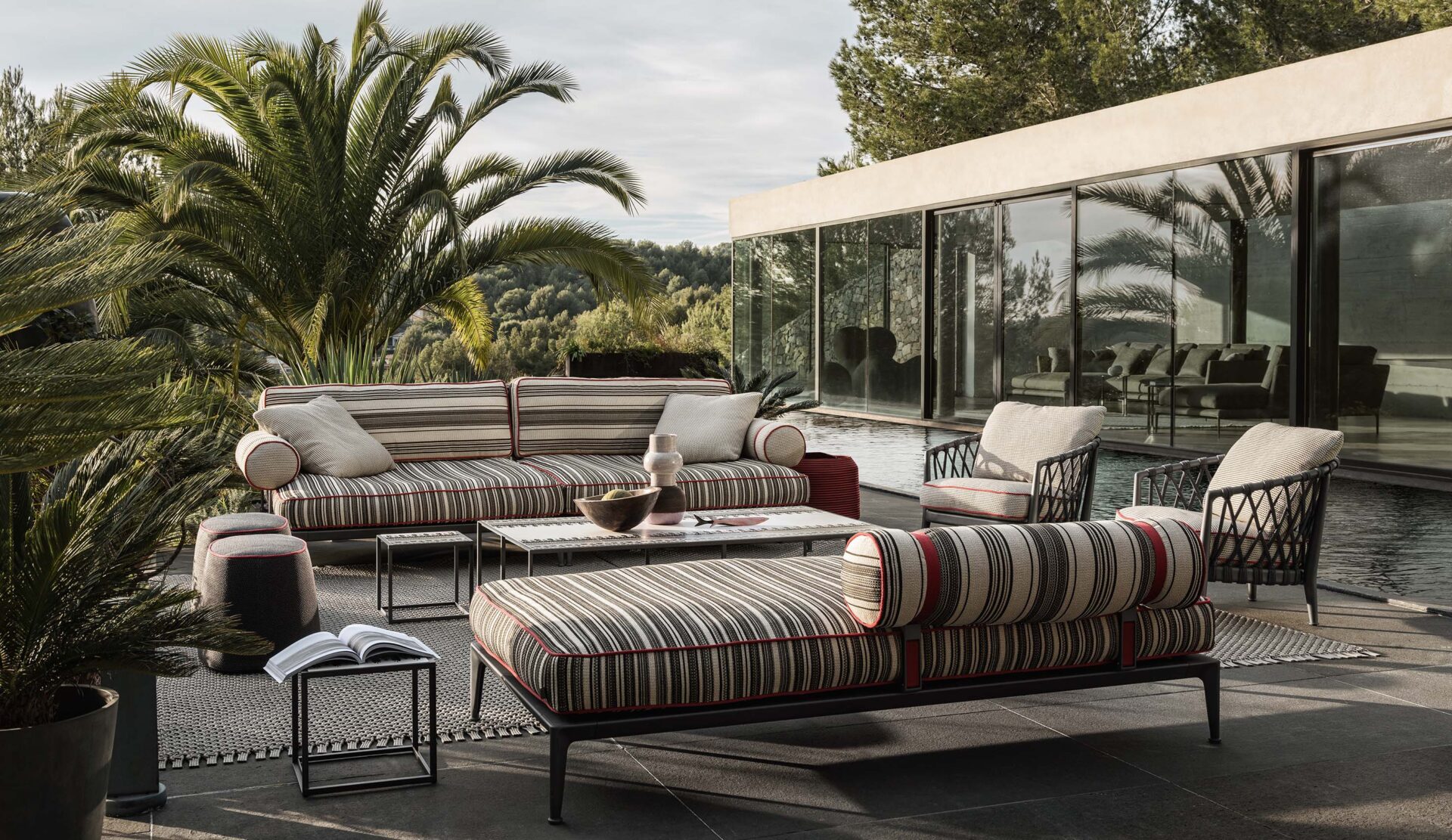
There are brands that do not merely produce objects, but build a language. This is the case for Arclinea, B&B Italia, Flos, and Maxalto: four names that, although born in different times and contexts, share the same cultural root—that of post-war Italian design, capable of transforming artisan carpentry and small furniture workshops into a world-renowned phenomenon. Today, these brands coexist under the umbrella of Flos B&B Italia Group (Design Holding), but their stories remain distinct, each with its own protagonists, insights, and iconic objects.
Arclinea: Kitchen as Architecture
It all began in 1925 in Caldogno, in the province of Vicenza, when Silvio Fortuna reopened a family carpentry shop that had been interrupted by World War I. For decades, the company worked with custom wood, but in the 1950s, the founder’s children—Angelo, Almerino, and Lena—pushed production toward series manufacturing. In 1960, the workshop took the name Arclinea, an acronym for “Arredamenti Razionali Componibili” (Rational Modular Furnishings), which was already a manifesto in itself. The kitchen was no longer seen as a simple service room, but as a true architectural project for the domestic space.
The technological leap came in 1963 with Claudia, the first Italian kitchen with built-in appliances, presented at the Salone del Mobile in Milan. Over the following years, designers such as Lucci & Orlandini, Carlo Bartoli, Ettore Sottsass, Roberto Pamio, and Enzo Berti collaborated with the company. However, from the late 1980s onward, Arclinea found its defining author: Antonio Citterio. In 1988, he designed Italia, the first kitchen to bring the technical rigor of professional kitchens into the home, complete with stainless steel surfaces and generous worktops. Since then, Citterio has remained the sole art director of the brand, signing models such as Convivium, Artusi, and more recently, Kora.
In 2016, Arclinea became part of Flos B&B Italia Group.

B&B Italia: The Polyurethane Revolution
While Arclinea emerged from wood, B&B Italia was born from an insight into materials. In 1965, Piero Ambrogio Busnelli—an entrepreneur from Meda with only an elementary school education but an extraordinary business intuition—discovered injection molding and polyurethane at a fair in London. Returning to Italy, he involved Cesare Cassina, and together they founded C&B (Cassina & Busnelli) in 1966. It was the beginning of a mini-revolution: for the first time, cold-molded polyurethane foam was applied to the production of upholstered furniture, starting with Coronado, designed by Afra and Tobia Scarpa.
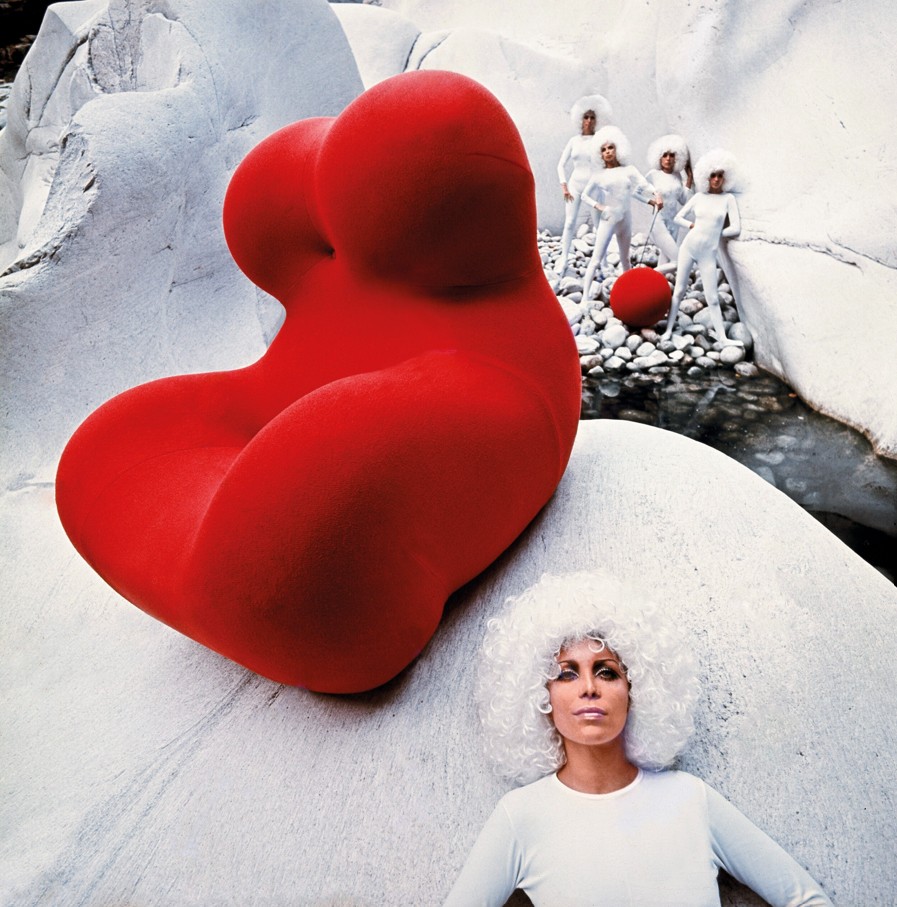
The years that followed were a succession of icons: Gaetano Pesce’s Up Series (1969), “vacuum-packed” armchairs that self-formed once released from their packaging, which also became a feminist manifesto included in the permanent collection of MoMA in New York; Mario Bellini’s Amanta; and Marco Zanuso’s Lombrico. In 1973, Busnelli bought out Cassina’s shares and renamed the company B&B Italia. From then on, the brand built its legacy through avant-garde communication—B&B was the first Italian furniture company to advertise on television—and through collaborations with some of the biggest names in international architecture and design: Zaha Hadid, Patricia Urquiola, Naoto Fukasawa, Jean-Marie Massaud, and naturally Antonio Citterio, who designed the Sity seating system in 1987, awarded the Compasso d’Oro.
Led by his son Giorgio Busnelli and later by the third generation of the family, B&B Italia entered the perimeter of the Investindustrial fund in 2015, and in 2018 merged with Flos and Danish brand Louis Poulsen into Design Holding.

Flos: When a Lamp Becomes Sculpture
Flos was also born from an encounter between entrepreneurial vision and design genius. The setting was Merano in the early 1960s: Dino Gavina, who had already worked with brothers Achille and Pier Giacomo Castiglioni, decided it was time to reinvent lighting. In 1962, Flos was born—from the Latin flos (flower)—along with the cocoon technique: a polymer previously used by the US military as packaging material, reinterpreted by the Castiglioni brothers and Tobia Scarpa to create extraordinary lamps like Taraxacum, Viscontea, Gatto, and Fantasma.
In 1963, Sergio Gandini joined the company, later becoming CEO and Chairman; together with the designers, he transformed Flos into a true light research laboratory. In 1962, Arco was created by Achille and Pier Giacomo Castiglioni: a stainless steel arch anchored to a marble base, capable of directing light to the center of a room without hanging from the ceiling—one of the most copied and iconic lamps of 20th-century design. This was followed by Toio, Taccia, Snoopy, and in 1979, Parentesi by Achille Castiglioni and Pio Manzù, the company’s first Compasso d’Oro.
In the 1980s, his son Piero Gandini took up the mantle and recognized the talent of a then-young Philippe Starck, launching a long collaboration that produced pieces like the Arà lamp and the iconic Miss Sissi. In subsequent years, other highly talented international designers began collaborating with Flos, including Antonio Citterio, Piero Lissoni, Jasper Morrison, Konstantin Grcic (Compasso d’Oro in 2001 with May Day), Patricia Urquiola, and into the 2010s with Michael Anastassiades, Ronan & Erwan Bouroullec, Formafantasma, and many others. In 2018, together with B&B Italia and other high-end furniture and lighting brands, Flos joined the Flos B&B Italia Group.

Maxalto: The Understated Luxury of Contemporary Classic
The last of the four brands was created in 1975 as a more artisanal offshoot of B&B Italia. The name itself, Maxalto, derives from the Venetian dialect “massa alto,” meaning “the highest”: an explicit goal of excellence in material craftsmanship, particularly wood. Its first interpreters were once again Afra and Tobia Scarpa, who designed furniture inspired by ancient luthiery and cabinetmaking techniques, such as the Africa chair from the Artona collection.
In 1993, the brand entered a new phase with the arrival of Antonio Citterio as its sole designer, a role he holds to this day. Under his direction, Maxalto developed what he defines as “modern neoclassicism”: a dialogue between the bourgeois forms of the early 20th century—referencing interwar French design and Jean-Michel Frank—and a contemporary sensitivity made of essential geometries and precious materials, from Chilean tineo wood to parchment. This yielded pieces such as the Febo sofa, the Pathos table, and the Max desk, which have become staples of the collection.

Four Stories, One Destination for Verona
Arclinea, B&B Italia, Flos, and Maxalto remain distinct brands today, each with its own voice, yet united by a shared concept of Italian design: rigorous, refined, and built to last. For those in Verona and its province wishing to experience them firsthand, the local benchmark is Ballarini Interni—a historic regional entity that for generations has served as the bridge between major Made in Italy brands and local clientele, featuring historic showrooms in Valgatara di Valpolicella and Marco di Rovereto.
To these is now added a new, highly anticipated chapter: the Affi location, strategically situated along the Lake Garda axis, which will serve as the exclusive “Premium Dealer” for Arclinea in Verona and its province. A new space where the history of these brands—made of workshops turned into industries, families passing down a passion for design, and creators who changed the way Italians live in their homes—continues to be written today right in the Verona region.